


Quick answer
In the Olist order snapshot, 1,028 of 92,498 orders with a recorded approval timestamp (1.11%) ended with canceled or unavailable status. Those included 433 canceled and 595 unavailable orders. Verify the fulfillment record as well as the approval event before confirming stock or shipping.
Key findings and sources
Canceled and unavailable orders can already have approval recorded
Next Order HQ’s Olist replay found 1,028 of 92,498 orders with an approval timestamp (1.11%) had a final observed status of canceled or unavailable.
Olist, Brazilian E-Commerce Public Dataset
92,580 Olist orders purchased January 2017 through July 2018, separated by whether an approval timestamp is present Add 433 canceled and 595 unavailable rows with a populated approval timestamp, then divide by 92,498.
Unavailable accounted for 595 approval-recorded orders
In the Olist snapshot, 595 of 92,498 orders with approval recorded were marked unavailable. This does not identify whether stock or another operational constraint caused the final status.
Olist, Brazilian E-Commerce Public Dataset
92,580 Olist orders purchased January 2017 through July 2018, separated by whether an approval timestamp is present Count rows with status unavailable and a nonblank order_approved_at.
A blank approval field did not rule out delivery
Among 82 Olist orders without a recorded approval timestamp in the selected cohort, 14 were delivered and 63 were canceled. This is a data-completeness observation, not a causal comparison.
Olist, Brazilian E-Commerce Public Dataset
92,580 Olist orders purchased January 2017 through July 2018, separated by whether an approval timestamp is present Cross-tabulate final observed order status among rows whose approval timestamp is blank.
Most canceled or unavailable orders already had the timestamp
Of 1,091 Olist orders marked canceled or unavailable in the historical cohort, 1,028 (94.23%) had a recorded approval timestamp.
Olist, Brazilian E-Commerce Public Dataset
92,580 Olist orders purchased January 2017 through July 2018, separated by whether an approval timestamp is present Count approval timestamp presence among all final canceled and unavailable rows.
Compare the results
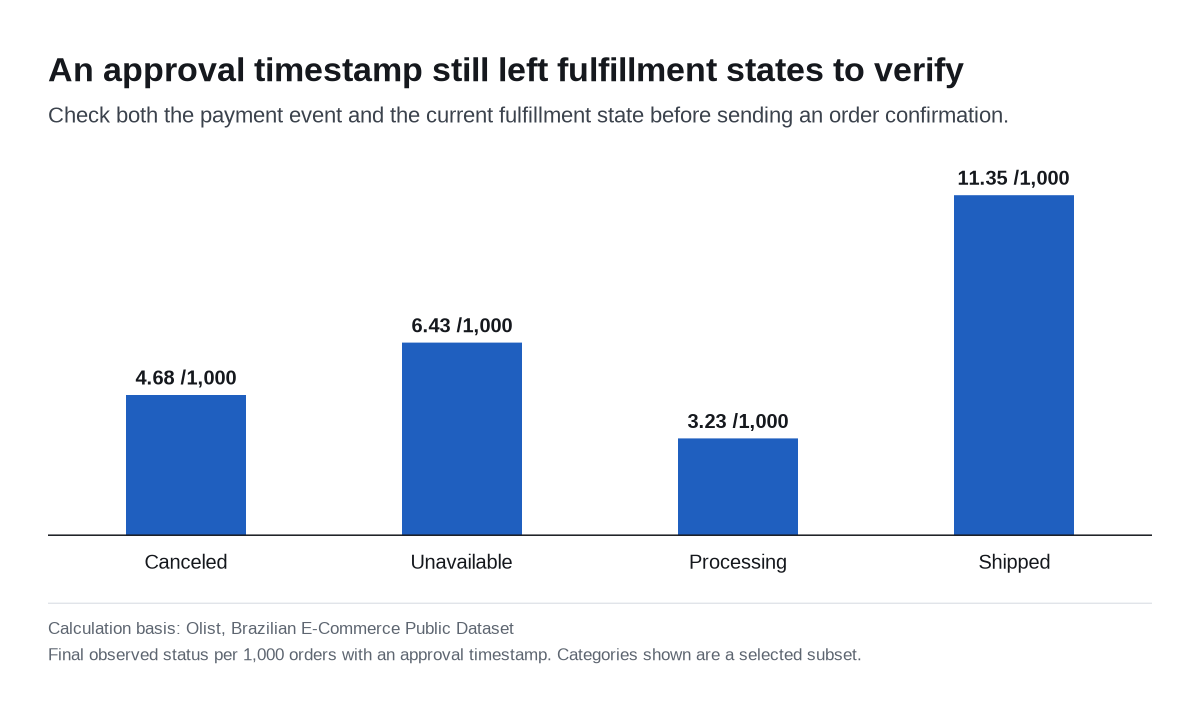
An approval timestamp still left fulfillment states to verify
Check both the payment event and the current fulfillment state before sending an order confirmation.
An event log and a fulfillment snapshot answer different questions
A recorded approval timestamp establishes that the source contains an approval entry. It does not establish that the order can ship. In the Olist order snapshot, final status can be canceled or unavailable even when the approval field has a value.
Of 92,498 orders with approval recorded, 595 were unavailable and 433 canceled in the snapshot. The same group contained 89,846 delivered orders, 1,050 marked shipped and 299 processing. Keep those categories separate when designing a customer confirmation.
Handle a blank approval field as unresolved
Only 82 rows lacked an approval timestamp in this cohort. They included 14 delivered and 63 canceled orders. The small missing-field group is useful for understanding data completeness, rather than estimating the effect of approval on delivery.
A blank field can reflect data lag, a different path through the order system or missing records. If the store has a separate payment provider, inventory reservation and order system, retrieve each signal for the exact order ID and present the result at the stage it supports.
Confirm what can actually ship
A recovery reply can acknowledge that the order exists while saying that stock or fulfillment is still being checked. When the item is unavailable, verify whether the merchant can reserve a different variant or needs to offer a refund path before suggesting a replacement.
In operations, track orders with conflicting state signals as a distinct category. Measure when each conflict clears and what the shopper sees at the time. This is more actionable than a single approved-or-failed indicator that treats every terminal and pending status the same.
Study data
| Measure | Value | Context |
|---|---|---|
| Timestamp present orders | 92,498 orders | Original snapshot status count |
| Timestamp present delivered | 89,846 orders | Original snapshot status count |
| Timestamp present canceled | 433 orders | Original snapshot status count |
| Timestamp present unavailable | 595 orders | Original snapshot status count |
| Timestamp present shipped | 1,050 orders | Original snapshot status count |
| Timestamp present processing | 299 orders | Original snapshot status count |
| Timestamp present invoiced | 273 orders | Original snapshot status count |
| Timestamp present approved | 2 orders | Original snapshot status count |
| Timestamp present created | 0 orders | Original snapshot status count |
| Timestamp absent orders | 82 orders | Original snapshot status count |
| Timestamp absent delivered | 14 orders | Original snapshot status count |
| Timestamp absent canceled | 63 orders | Original snapshot status count |
| Timestamp absent unavailable | 0 orders | Original snapshot status count |
| Timestamp absent shipped | 0 orders | Original snapshot status count |
| Timestamp absent processing | 0 orders | Original snapshot status count |
| Timestamp absent invoiced | 0 orders | Original snapshot status count |
| Timestamp absent approved | 0 orders | Original snapshot status count |
| Timestamp absent created | 5 orders | Original snapshot status count |
| Approval recorded, canceled per 1,000 | 4.68 orders per 1,000 | Original recomputed share or rate |
| Approval recorded, unavailable per 1,000 | 6.43 orders per 1,000 | Original recomputed share or rate |
| Approval recorded, processing per 1,000 | 3.23 orders per 1,000 | Original recomputed share or rate |
| Approval recorded, shipped per 1,000 | 11.35 orders per 1,000 | Original recomputed share or rate |
What changes when you compare the figures
| Comparison | Result | Calculation |
|---|---|---|
| Approval recorded, canceled per 1,000 | 4.68 orders per 1,000 | = 433 / 92498 * 1000 |
| Approval recorded, unavailable per 1,000 | 6.43 orders per 1,000 | = 595 / 92498 * 1000 |
| Approval recorded, processing per 1,000 | 3.23 orders per 1,000 | = 299 / 92498 * 1000 |
| Approval recorded, shipped per 1,000 | 11.35 orders per 1,000 | = 1050 / 92498 * 1000 |
| Canceled or unavailable share with approval recorded | 1.11% | = 1028 / 92498 * 100 |
| Approval recorded among canceled or unavailable orders | 94.23% | = 1028 / 1091 * 100 |
| Delivered share with an approval timestamp | 97.13% | = 89846 / 92498 * 100 |
Methodology and sources
Filter order purchases from 1 January 2017 through 31 July 2018. Classify each row by whether order_approved_at is nonblank. Cross-tabulate the final observed order_status, without dropping canceled, unavailable or undelivered statuses. Report shares per 1,000 orders with the timestamp present. This is a timestamp-presence check, not a reconstruction of payment, capture, reservation or fulfillment events.
Download the source data (CSV)
Download the calculations (CSV)
Download the citation notes (CSV)
Download the evidence behind the new findings (CSV)
Related reading
Ecommerce delivery promise statistics for early arrivals and late orders
Online stockout statistics and what an out-of-stock notice measures
Inventory availability and store pickup statistics
Retail inventory accuracy statistics and where stock promises fail
Sources and definitions
Olist, Brazilian E-Commerce Public Dataset
The source data includes the population, period, denominator and limitations for every figure.